>
Skip to product information
1 of 5

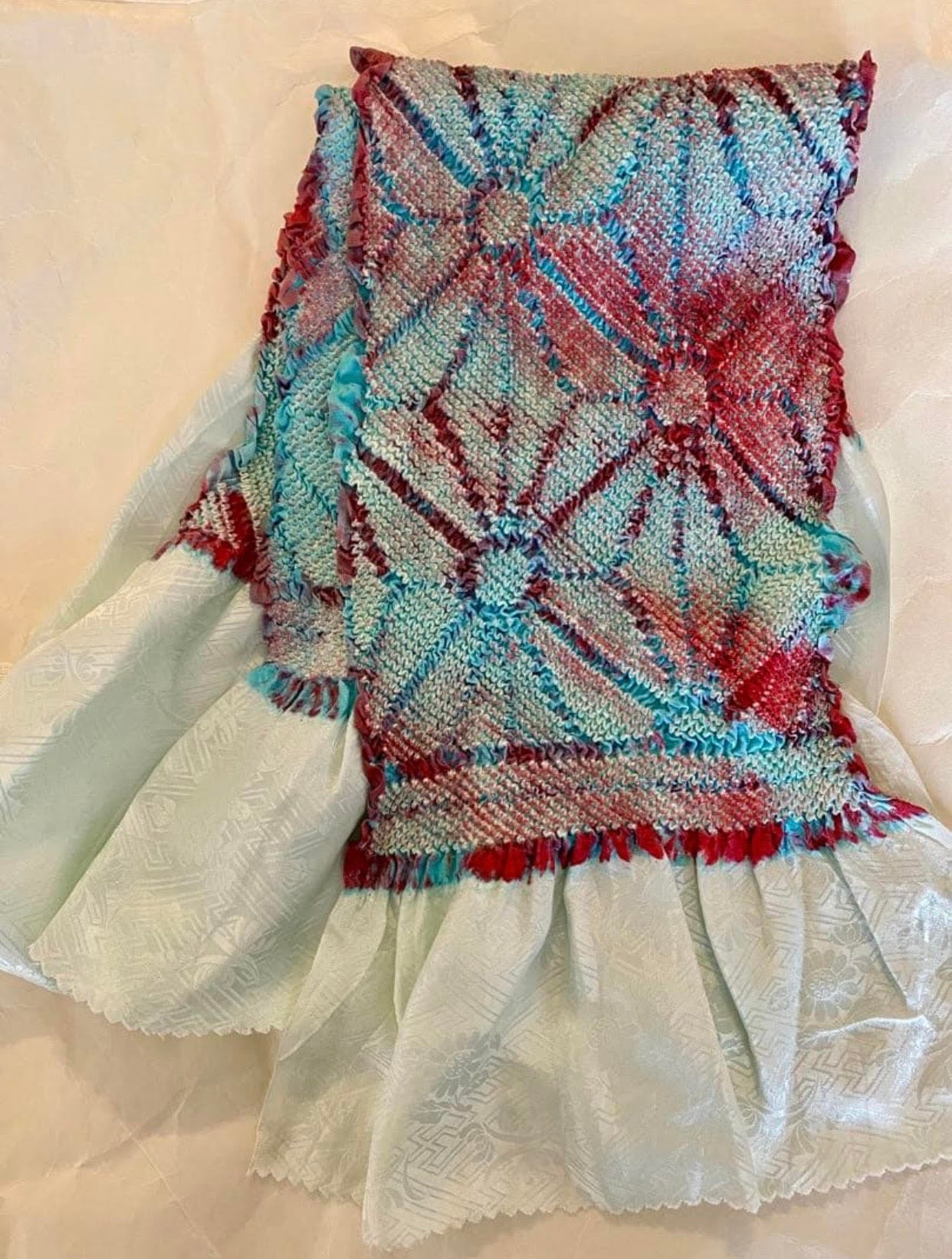
All-Over Shibori Silk Obiage with Geometric Pattern 1965-1975

All-Over Shibori Silk Obiage with Geometric Pattern 1965-1975

Regular price ¥20,000 JPY
Regular price Sale price ¥20,000 JPY
Sale Sold out

※ Shipping included · Duties and taxes not included
※ Livraison incluse · Droits de douane et taxes non inclus

« Pour la version française, veuillez consulter ci-dessous.»


(English)

Click on the photo to enlarge it


All-Over Shibori Silk Obiage with Geometric Pattern  

1965-1975

 Hand-dyed made by skilled artisans using carefully selected Japanese silk, 

This silk obiage is created using the traditional Japanese dyeing technique known as shibori.

Shibori involves binding, stitching, folding, or compressing the fabric before dyeing so that certain areas resist the dye.
When the threads are removed, a textured pattern of small raised forms appears.

In this piece, the technique is applied across the entire textile in an all-over shibori design, creating a dynamic geometric composition.

Shibori dyeing has been practiced in Japan for centuries and represents a highly refined form of hand craftsmanship.

Originally worn as an obiage, a decorative silk cloth used with a kimono obi, the soft silk and sculptural texture also make it suitable for use as a scarf.
* Profile International license holder who conveys kimono culture


(Français) 

Cliquez sur la photo pour l'agrandir.

Obiage en soie entièrement en shibori à motif géométrique
So Shibori (technique japonaise de teinture par nouage)

Teint à la main par des artisans qualifiés à partir de soie japonaise soigneusement sélectionnée, années 1970

Cet obiage en soie est réalisé selon la technique traditionnelle japonaise de teinture appelée shibori.

Le shibori consiste à nouer, plier ou comprimer le tissu avant la teinture afin de créer des zones résistantes au colorant.
Lorsque les fils sont retirés, des motifs texturés et légèrement en relief apparaissent.

Dans cette pièce, la technique est appliquée sur toute la surface du textile en shibori intégral, formant une composition géométrique dynamique.

La teinture shibori est pratiquée au Japon depuis des siècles et représente un savoir-faire artisanal très raffiné.

À l’origine, l’obiage est un accessoire porté avec le kimono pour maintenir et décorer l’obi.
Grâce à sa soie souple et à sa texture sculpturale, cette pièce peut également être portée élégamment comme écharpe ou foulard.

* Profil: Titulaire d'une licence internationale, ambassadrice de la culture du
kimono


** EU customs:Please note that VAT and customs duties will be charged upon delivery and are the responsibility of the buyer.

** HS Code: 6214.10  Discription: Vintage silk Shibori obiage, Material: 100% silk, Country of origin: Japan

** Please note that international orders may be subject to import duties, VAT, and customs clearance fees. For customers in the European Union, the total charges are typically between 25-35% of the declared item value. These charges are determined by the destination country and are the responsibility of the recipient.

(Example: France - approx. 28-35%, Italy - approx. 25-35%, Germany - approx. 25-30%)

*写真の上をクリックすると拡大して見られます。

総絞り帯揚げ 幾何学文様

1970's

今は帯揚げの絞り加工はほとんどが機械化されているのをご存知ですか? 総絞りなども機械で均一な絞りがあっという間に製造される時代です。特別な注文や高級なものは、手作業もありますがそれはほんの僅かです。職人の激減とどんどん進む機械化によってです。

手絞りと機械絞りの違いは、風合いや細かい柄の出方です。手絞りはひとつひとつの絞りに個性があって、独特の立体感が出ます。機械絞りは均一で綺麗に揃っていますが、風合いはありません。

こちらは、作るのに何週間,何ヶ月も掛かったの時代の,その中でも高級な帯揚げです。手に取るだけで,手絞りの温かみを感じます。もう今はほぼ再現されなくなった日本文化の芸術だと思っています。

1970年代は100%手作業でした。
また絹は厳選された規格を通ったものが使われていたので、絹の光沢,柔らかさが今の輸入もの,国産のものとは全く違います。

卓越した職人による最上級の絹の全盛期のものはもう再現されなくなったこの時代に、本物の価値のあるものを一つ,二つとお持ちになることは、機械生産のものを数多く持つより,豊かに思います。


*プロフィール
着物文化を伝える国際免許保持者

 
Quantity

Out of stock

View full details

Collapsible content

Collapsible row

Collapsible row

Collapsible row